Thursday, April 7, 2022

Words for mushrooms and other fungi, Part 11

[This entry is taken from a chapter of Part II of the open-source textbook Spanish-English Cognates: An Unconventional Introduction to Spanish Linguistics.]

[Go to Part 1 of Words for Mushrooms and Other Fungi]


Common mushrooms: Maitake or hen-of-the-woods mushroom

Maitake is another common mushroom with a Japanese name. The word maitake is not found in as many dictionaries as the word shiitake. The American Heritage Dictionary, which is an exception, defines it as ‘an edible polypore mushroom… that produces large clusters of overlapping gray or brown fan-shaped caps, grows at the base of trees or in cultivation, and is prized in Japanese cuisine and used as a dietary supplement’ (AHD). A polypore is a bracket or shelf fungus that expels its spores through fine tubes or pores on its underside. This word is an anglicization of the New Latin term polyporus introduced by Italian botanist Pier Antonio Micheli in 1729. It contains the prefixoid poly‑ ‘many’ and the Latin noun pŏrus ‘pore, passage in the body’ (source of learned Eng. pore and equally learned Sp. poro), referring to the pores or tubes from which spores are expelled.

Figure 9: Maitake mushroom[i]

Maitake is a parasitic (although not lethal) mushroom native to China, (mostly northern) Europe, and (mostly northeastern) North America and it is one of the main culinary mushrooms in China and Japan. Since it can be cultivated, it can be found in many places besides its original native habitats.

The Japanese word maitake (舞茸) translates literally as ‘dancing mushroom’. It is formed from the stem 舞い/まい (mai) of the verb 舞う/まう (mau) ‘to dance’, plus the word take (茸) meaning ‘mushroom’ (see above). In addition to its Japanese name, this mushroom traditionally goes by a variety of names in English that allude to the shape of these mushroom clusters, such as hen-of-the-woods (not to be confused with chicken-of-the-woods, see below),[1] sheepshead mushroom, ram’s head, and sheep’s head. In Spanish, it is also known as maitake, though the name cabeza de oveja ‘sheep’s head’ is also used, which is probably just a calque of its English name. But, again, maitake is not common to any of the regions where Spanish is spoken.[ii]

The scientific (botanical) name for this mushroom is Grifola frondosa, assigned to it by British botanist Samuel Gray in 1821.[iii] The genus name Grifola is an adaptation of the Ancient Greek word γρῖφος (grîphos) ‘conundrum, riddle’ and perhaps also ‘intricate’ (originally, it meant ‘fishing basket’). As for the appellative frondosa, that is the feminine form of a common Latin word, frondōsus/a ‘leafy, full of leaves’ (cf. Sp. frondoso/a).[2]

Go to Part 12


[1] The mushroom hen-of-the-woods should not be confused with chicken of the woods, also known as chicken mushroom, a name for mushrooms of the genus Laetiporus, especially Laetiporus sulphureus, see below.

[2] The Latin adjective frondōsus/a was derived from the noun frōns, genitive frondis (root: frond‑), that meant ‘leafy branch, green bough, foliage’. This noun has given us the rare Spanish noun fronda ‘foliage’. This Latin word frōns should not be confused with another Latin frōns, genitive frontis, from which we get Eng. front and frontal and Sp. frente and frontal.


Words for mushrooms and other fungi, Part 10

 [This entry is taken from a chapter of Part II of the open-source textbook Spanish-English Cognates: An Unconventional Introduction to Spanish Linguistics.]

[Go to Part 1 of Words for Mushrooms and Other Fungi]


Common mushrooms: Shiitake or black mushroom

Besides the champignon or button mushroom, there are several other common types of edible mushrooms that are well known in different versions of Western cuisine, as well as other cuisines around the world. Here we will look at some of the most common ones. We shall start with the shiitake mushroom, which is native to East Asia.


Figure 8: Shiitake mushroom growing on wood [i]

In English, shiitake is also known by a variety of other names, including sawtooth oak mushroom, black (forest) mushroom, (Chinese) black mushroom, and golden oak mushroom. The botanical name for these mushrooms is Lentinula edodes.[ii]

The word shiitake (椎茸)[1] is a Japanese compound word formed by the word shii (椎), the name of a type of East Asian tree, the chinquapin or chinkapin in English, of the genus Castanopsis, on which these mushrooms grow in the wild, and the word take (茸) that means ‘mushroom’.[2] Today, most commercially available shiitake mushrooms are cultivated.

In Spanish, this mushroom is also known by its Japanese name shiitake (an unassimilated word, not in the DLE yet) or, more commonly, as seta china ‘Chinese mushroom’. As we can see from the name seta china, this mushroom is not just found in Japan, but rather in much of East Asia. This mushroom is commonly found in Chinese food. Its Chinese name is es xiānggū (香菇) which means ‘fragrant mushroom’. In Vietnamese, its name is nấm hương; in Thai, เห็ดหอม (hèt hŏm); and in Korean (hangul alphabet), 표고 (pyogo).

There are some types of East Asian mushrooms that are known as ‘high-grade shiitake’. One is called dōnggū (冬菇) in Mandarin, a name that means literally ‘winter mushroom’. In Japanese, it is known as donko (冬菇), obviously a loanword from Chinese. In English, it is also known as Chinese black mushroom. Another ‘high-grade’ shiitake is called huāgū (花菇) in Chinese, which literally means ‘flower mushroom’.

The botanical name Lentinula edodes for this species of mushroom is a bit hard to explain. It belongs to the Lentinula genus (formerly Lentinus), which has only 8 species. The original genus name Lentinus was given to this species by Franklin Sumner Earle in 1909. It seems to be derived ultimately from the root lent‑ of the Latin adjective lentus, which could mean ‘slow’ like its Spanish descendant lento/a ‘slow’, but also ‘flexible, pliant’, among other things, and that seems to be what Earle had in mind. After the root, we identify the adjective-forming suffix ‑īn‑(us) ‘of or pertaining to’. Originally, shiitake was given the scientific name Agaricus edodes by Miles Joseph Berkeley in 1877, but it was changed to the Lentinula genus by David Pegler in 1976. As for the edodes epithet, it seems that it may have been created based on the Latin verb edĕre ‘to eat’, though what it is supposed to mean is not clear, for it is clearly a badly formed ‘Latin’ word.

Go to Part 11


[1] The Japanese name is written 椎茸 or 香蕈 in kanji script and しいたけ in hiragana.

[2] The words chinquapin or chinkapin can refer to different things: (1) ‘any of the shrubs in the genus Castanopsis’; (2) ‘any of the several trees and shrubs in the genus Chrysolepis’; (3) ‘some of the species in the chestnut genus Castanea’, among other things (Wikipedia). The word chinquapin comes from Virginia Algonquian, borrowed into English in the 17th century, ‘probably modification of Virginia Algonquian chechinquamin ‘chinquapin nut’’ (Merriam-Webster’s Collegiate).


[i] Source: By frankenstoen from Portland, Oregon - Shiitake Mushrooms, CC BY 2.0, https://commons.wikimedia.org/w/index.php?curid=7304024 (2022.01.22)


Wednesday, April 6, 2022

Words for mushrooms and other fungi, Part 9

[This entry is taken from a chapter of Part II of the open-source textbook Spanish-English Cognates: An Unconventional Introduction to Spanish Linguistics.]

[Go to Part 1 of Words for Mushrooms and Other Fungi]


Eng. champignon ~ Sp. champiñón

The prototypical mushroom has a round disk-like top with a slender stalk. The most common type of mushroom, the one most people associate with the word mushroom is the cultivated white button mushroom which is native to grasslands in Europe and North America and which is cultivated in many countries. Its botanical name is Agaricus bisporus, cf. Figure 3.[i] According to Wikipedia,

Agaricus bisporus is an edible basidiomycete mushroom native to grasslands in Europe and North America. It has two color states while immature – white and brown – both of which have various names, with additional names for the mature state. A. bisporus is cultivated in more than seventy countries and is one of the most commonly and widely consumed mushrooms in the world.[ii]


Figure 6: Agaricus bisporus (common mushroom or button mushroom)[iii]

This mushroom goes by several common names in English, such as common mushroom, button mushroom, table mushroom, and champignon mushroom, or just simply champignon, (pronounced [ʧamˈpʰɪnɪən] or [ʃamˈpʰɪnɪən]). The name champignon, which is not common and is probably not known by most speakers of English, is cognate with the most common name for this type of mushroom in Spanish too, namely champiñón (pronounced [ʧampiˈɲon]). How these cognates are used differs a great deal, however. Thus, an average English speaker, at least one who is not an avid mushroom enthusiast, will refer to these mushrooms as just plain mushrooms, unless they were trying to differentiate from other varieties, whereas a Spanish speaker would always refer to them as champiñones, and not as hongos or setas.

The cognates Eng. champignon and Sp. champiñón are both loanwords from French champignon [ʃɑ̃piˈɲɔ̃], which is the generic word for ‘mushroom’ in Modern French. This word’s ultimate source is Vulgar Latin *campānĭŏlus ‘product of the field’, a word derived from Late Latin campānĕus/campānĕa (or campānĭus/campānĭa) ‘pertaining to fields’, itself derived from Latin campus ‘open or flat space; plain’, cf. Late Latin campānĭa ‘open country, battlefield’, source of Eng. campaign and Sp. campaña (and French campagne ‘countryside’ and champagne ‘champagne’).[1]

French champignon is first attested in 1398, presumably as a variant (by change of suffix) of Old French adjective champignuel (champineul, c. 1350; the adjective canpegneus is attested in the 12th century). O.Fr. champignuel descends from Vulgar Latin campaniolus, derived from the noun  campānĭa by means of the suffix ‑ŏlu. The adjective was used in the phrase fungus campaniolus ‘field mushroom’, from which the first part was removed, turning the adjective campaniolus into a noun. In other words, Fr. champignon (from an earlier champignuel) came to replace (in French) the original Latinate word for ‘mushroom’ that descended from Lat. fungus.

English borrowed the word champignon from French originally to refer to fungi or mushrooms in general, just like the original French word does, as a replacement of the word mushroom, at least in some varieties of English. The word is first attested in writing in the latter part of the 16th century. In the 18th century, however, the meaning of Eng. champignon became more restricted when it came to refer to edible mushrooms, and later it became restricted to some species of edible mushrooms. Dictionaries differ as to what that species is. the species Agaricus campestris a mushroom related to Agaricus bisporus, and other related varieties. According to the Oxford English Dictionary (OED) and the Oxford American Dictionary (OAD), the word champignon refers today to the botanical species Marasmius oreades, also known as Fairy Ring Agaric, (also known as field mushroom and in North America, as meadow mushroom. Other dictionaries, however, say the term champignon is less specific as to the species and point to Agaricus bisporus as the main type that goes by that name.[2] In Spanish, the word champiñón is a very recent loanword. It barely registers in the written record before 1925 and it does not appear in the Academy’s dictionary until 1928. It is only after 1950 that it truly becomes a common word in the written record.

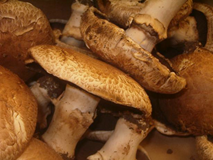
The name champignon for this species of mushroom is reserved for its immature form, which is white and small. When it matures, the mushroom is brown and has a larger cap. When the mature mushroom reaches a size of 4-6” in diameter, it is marketed as portobello mushroom, sometimes spelled portabella or portobella, as the etymological source of the first part of this name is disputed.[iv] The name has been calqued into Spanish as hongo portobello, seta portobello, or even champiñón portobello. A portobello mushroom is 4"-6" in diameter. A young or juvenile portobello is sometimes known as a crimino mushroom (plural: crimini), but also as cremini, baby bellas, golden Italian mushrooms, and brown mushrooms, among other possibilities. The word cremini or crimini comes from Italian cremini, plural of cremino, a word derived from crema ‘cream’, usually referring to chocolate truffles or creamy morsels of cheese.


Figure 7: Portobello mushrooms[v]


[1] Originally, the Latin common noun campania comes from the place name Campania, ‘the very fruitful and luxurious … province of Campania, in Middle Italy, whose chief city was Capua, now Terra di Lavoro’ (CTL). The name is derived from the Latin word campus ‘open, level land’, source of Eng. campus and Sp. campo.

The ancestor of Fr. champignon with a final n is not attested. What is attested is Old French champigneul, with a final l, a cognate of Italian campignuolo, from an unattested Vulgar Latin *campinolius (OED).

Fr. champignon is first attested Eng. champignon is first attested in writing in the late 16th century.

In some northern French varieties from which modern standard French derives, the Latin C, pronounced [k], came to be pronounced [ʧ] and eventually to be written 〈ch〉 (later, the sound changed to [ʃ] in French, but not in English or Spanish).

As we saw, French has the doublet campagne and champagne. The latter is obviously native to the variety of French from which Standard French derives, since it has the expected ch sound change. The source of campagne is most likely a northern variety of French, such as Norman or Picard, in which the sound change in question did not take place.

[2] The American Heritage Dictionary defines champignon as ‘an edible mushroom, especially the much cultivated species Agaricus bisporus’ (AHD). The, on the other hand, defines the word as ‘a small edible mushroom with a light brown cap, growing in short grass in both Eurasia and North America and widely grown commercially. Also called meadow mushroom, field mushroom. Agaricus campestris, family Agaricaceae, class Basidiomycetes’ (OAD). The OED’s definition is the following: ‘A name applied originally (as in French) to fungi, or mushrooms generally; in 18th cent. to edible mushrooms, esp. Agaricus campestris; but, subsequently, restricted to the Fairy Ring Agaric (A. Oreades)’.


Words for mushrooms and other fungi, Part 8

[This entry is taken from a chapter of Part II of the open-source textbook Spanish-English Cognates: An Unconventional Introduction to Spanish Linguistics.]

[Go to Part 1 of Words for Mushrooms and Other Fungi]


Sp. hongo, Sp. seta, and Sp. callampa

In Spanish, the word hongo, the cognate of Eng. fungus (see above), which can be used with the generic meaning ‘fungus’, is used regularly to refer to mushrooms, whether they are edible (Sp. hongos comestibles) or not (Sp. hongos venenosos).[i] In some varieties of Spanish, however, the word seta is perhaps more common for at least the edible sense of the word hongo, though it can be applied to non-edible (poisonous) mushrooms as well.

So, both words seta and hongo can be used to refer to edible mushrooms in Spanish, though different varieties of Spanish may prefer one term over the other. If we search setas comestibles ‘edible mushrooms’ in Google we get about a quarter million hits and if we search hongos comestibles ‘edible mushrooms’ we get a few more, about 425,000. If you search for hongos comestibles in Google Books, you get about 24,100 results and if you search for setas comestibles, you get about 9,200 results, which suggests that there is a preference for hongo over seta among both experts and non experts. But there is no doubt that some experts in the study of mushrooms prefer the word seta, at least in some varieties of Spanish. In their entry for the word hongo, DCEH explains that the two words, hongo and seta, are synonymous in most varieties of Spanish, though in some, hongo may be preferred for the edible variety, in particular the variety Lactarius deliciosus, also known in Spanish as mízcalo,​ níscalo, robellón, or rebollón (cf. Engl. saffron milk cap or red pine mushroom).[1]


Figure 5: Lactarius deliciosus (Saffron Milk Cap or Red Pine Mushroom)[ii]

According to DCEH, the word seta is most likely of pre-Roman origin since it is not found in any other Romance language besides Spanish. There is another theory, although not a very likely one, namely that seta came from Ancient Greek σηπτά (septá) ‘rotten things’, neuter plural wordform of σηπτóς (septós), from which would the sense ‘mold, mildew, moss, slime’ could have derived and, from there, the sense of ‘low quality mushroom’ and, further, ‘mushroom in general’ (DCEH).

In the Spanish of the Andean countries of Bolivia, Chile, Ecuador y Perú, the common local word for ‘mushroom’ is callampa, a loanword from Quechua k’allampa or ccallampa (the latter spelling found in the DLE as the source of Sp. callampa). The word callampa is found in the DLE, the language academies’ dictionary. This dictionary tells us as well that Sp. callampa is also a vulgar word for ‘penis’ in Bolivia and Chile, among other things.

In Spanish, the word boleto is used for some types of mushrooms, though it is not a regular word for mushroom, unlike in Catalan, where the word bolet is the ‘the general word for mushrooms’, though ‘it tends to refer to wild mushrooms’, whereas xampinyó (cognate of Sp. champiñón) refers to ‘the standard mushrooms you buy in the supermarket’.[iii] Most Spanish dictionaries do not even mention this sense for the word boleto or the existence of a second word boleto in addition to the one that means ‘ticket for a show or seat’ or ‘coupon’, depending on the dialect. (One that does is Clave, which incorrectly treats it as a single word, not two separate words.) That word boleto is derived from the word boleta ‘ticket’ (in American Spanish), which is a loanword from Italian bolletta ‘safe-conduct’, a diminutive of bolla ‘seal’. The word boleto for mushrooms has a different, unrelated source, however. It is a loan from Lat. bōlētus ‘mushroom’, and in particular the highly valued porcine variety (see below), which itself is a loan from Ancient Greek βωλίτης (bōlitēs) ‘mushroom (especially Agaricus bisporus)’ (see below), a word of unknown origin. In botany, the Latin word bōlētus has been adopted for ‘a large genus of fungi, having the under surface of the pileus full of pores, instead of gills as in Agaricus’ (OED), which is the sense that Clave gives for this sense of Sp. boleto.[2]  Other languages have borrowed this word to refer to mushrooms of this genus, among them Eng. boletus or bolet, Fr. bolet, Sp. boleto, though these words are rather technical and rare. Another language besides Catalan in which a descendant of Lat. bōlētus is a generic word for ‘mushroom’ is German, which early on borrowed it from Latin, changing over time to the Modern German word Pilz (cf. Old High German buliz).

Speakers of some varieties of Spanish who are not well versed in mushrooms and their nomenclature and varieties often use a different word for mushrooms in general, at least for those in their common experience, a word that comes from French champignon and which is the regular word for mushroom in Modern French, though in theory Sp. champiñón refers to a particular type of mushroom. The word is champiñón in Spanish, which is cognate with Eng. champignon. We turn to these words next.

Go to Part 9


[1] The original quote (under hongo) says: ‘Desde antiguo [HONGO] le hace fuerte concurrencia SETA; en buena parte del territorio se emplean conjuntamente, con alguna distinción de sentido; en general puede decirse, como declara explícitamente Covarr[uvias], que el hongo es más apreciado que la seta, aunque también se han empleado como meros sinónimos; en el uso del Este de España se emplea especialmente hongo como nombre del Lactarius deliciosus (= cat. rovelló), la variedad más estimada por los gastrónomos’ (DCEH).

[2] Clave gives the following as an additional (unrelated) sense for the well-known word boleto: ‘mushroom that is characterized by having pores in the lower part of its cap and a thick foot, and that is edible or poisonous depending on the species’. The original says: ‘Seta que se caracteriza por tener poros en la parte baja de su sombrerillo y un pie grueso, y que es comestible o venenosa según la especie’ (Clave).


[iii] Source: http://www.catalandictionary.org/ (2022.04.12)


Tuesday, April 5, 2022

Words for mushrooms and other fungi, Part 7

 [This entry is taken from a chapter of Part II of the open-source textbook Spanish-English Cognates: An Unconventional Introduction to Spanish Linguistics.]

[Go to Part 1 of Words for Mushrooms and Other Fungi]


Eng. mushroom

As we saw in the preceding section, the English word mushroom, pronounced [ˈmʌʃ.ɹum] or [ˈmʌʃ.ɹʊm], refers to ‘a spore-producing fungal growth, often edible and typically having a domed cap with gills on the underside’ (COED). So, a mushroom is a type of fungus and, in particular, the part of a fungus that grows in plain sight, as opposed to the part that is hidden underground, the mycelium.

The word mushroom is a loanword from Anglo-Norman moscheron or musherum into Middle English, first attested in writing in the early 15th century. It seems to come from Old French mousseron, and eventually from ‘an unattested post-classical Latin’ mussariōn- (nominative musarĭō), of unknown origin. In Middle English it was also spelled musheron and many other different ways. French still has the word mousseron, also known as mousseron vrai ‘true mushroom’ or mousseron de Saint-Georges ‘Saint George’s mushroom’, a type of mushroom known in English also as St. George’s mushroom, so called because by this saint’s day, March 23, this mushroom can typically be found in this part of the world. Its botanical name is Calocybe gambosa, also known as Tricholoma georgii.[i] In modern French, however, the word mousseron is not used any longer to refer to mushrooms in general, for which the word champignon is now used instead (see below). In north-central Spain, this mushroom is much appreciated, and it is known as lansarón, nansarón, seta de San Jorge, or seta de primavera.[1]

Curiously, Spanish has a cognate of Eng. mushroom and Fr. mousseron, namely the botanical term mucerón, which is used in parts of Spain, though it seems to refer to different species of mushrooms in different places, among them the seta de San Jorge ‘Saint George’s mushroom’, also known as mucerón de primavera. Another species that the name mucerón is used for is one that has the botanical name Clitopilus prunulus, also known as mojardón, molinera, panadera, and harinera.[ii] In English, this mushroom is known as the miller or the sweetbread mushroom. You will not find these words in a regular Spanish dictionary, but you will in a mycological one.

Another word in English for mushroom is toadstool [ˈtʰoʊdˌstuɫ], first attested in the late 14th century (OED). This word is a transparent compound formed by the nouns toad (Sp. sapo) and stool (Sp. taburete, banqueta). The word toadstool is used today primarily for the round-top, prototypical type of mushroom and, in some varieties of English at least, it is used to refer to poisonous mushrooms while keeping the name mushroom is reserved for the edible ones.


Figure 4: Poisonous fly agaric mushroom (Amanita muscaria), an iconic toadstool species[iii]


[1] In Basque, it is known as perretxiko, a word that is also used in the Spanish of the Basque Country.

Monday, April 4, 2022

Words for mushrooms and other fungi, Part 6

[This entry is taken from a chapter of Part II of the open-source textbook Spanish-English Cognates: An Unconventional Introduction to Spanish Linguistics.]

[Go to Part 1 of Words for Mushrooms and Other Fungi]


Mushrooms: Introduction

Mushrooms are a delicacy for many people, more so in some cultures than others. We’re referring here to edible mushrooms, of course, since there are other types as well, in particular poisonous, medicinal, and psychotropic ones. A mushroom is basically the above-ground reproductive structure or ‘fruiting body’ (Sp. cuerpo fructífero) of fungi from the phylum Basidiomycota, which along with the phylum Ascomycota (sac fungi or ascomycetes) form the subkingdom Dikarya (‘higher fungi’) of the kingdom Fungi. Besides mushrooms, the phylum Basidiomycota contains other organisms, such as Cryptococcus, a genus of yeastlike fungus that includes some serious pathogens for humans.[1]

In other words, a mushroom is the part of a type of fungus that protrudes from its underground ‘network of fine white filaments’ known as mycelium [maɪ̯.ˈsiɫ.i.əm] (Sp. micelio).[2] As we just said, mushrooms can be used as a food, though some varieties are poisonous and even deadly.[i] A mushroom can be defined technically as ‘a spore-producing fungal growth, often edible and typically having a domed cap with gills on the underside’ (COED). Mushrooms can be of the saprotrophic type, which feed on decaying organic matter, or mycorrhizal, which have symbiotic association with plants, such as trees (see above).

In Figure 2 below, you can see a very common edible fungus (mushroom) commonly found in woodlands in Europe and North America, known popularly as clouded agaric or cloud funnel, whose botanical name is Clitocybe nebularis. There are about 300 species of the genus Clitocybe and many of them are poisonous. Unfortunately, it is not easy to discern whether a species of this genus is edible or not without a microscope. Clitocybe nebularis is considered edible by some, but others complain of gastric discomfort when they eat them.[ii]

Figure 2: clouded agaric or cloud funnel (Clitocybe nebularis)[iii]

There are more than 10,000 species of mushrooms. They can be divided into different types according to how they are used by humans. Most mushrooms are edible, but there are also poisonous ones as well as ‘magic’ ones, the least common, with hallucinogenic or mind-altering properties. Poisonous mushrooms have different degrees of toxicity to humans, causing from minor gastrointestinal discomfort to death. What makes a mushroom poisonous is toxins that the mushroom produces to defend itself, to prevent it from being eaten. Some mushrooms, however, want to be eaten for that is how their spores are spread by the animals who eat them, in their feces.

Many poisonous mushrooms look very similar to edible ones, which calls for caution when collecting wild mushrooms in the forest. Even among the harmless (non-poisonous) ones, many are not really fit for consumption because they may be too bitter, too tough, or too slimy. Mushrooms have also been used throughout time in folk medicine, the so-called medicinal mushrooms (Sp. hongos/setas medicinales), though there is little scientific evidence that such a thing exists. Finally, mushrooms can also be classified as to whether they are wild (Sp. hongos/setas silvestres) and found in the forests of the world, which are the vast majority of mushrooms, or whether they are cultivated varieties (Sp. hongos cultivados/setas cultivadas), which are the ones that we find in stores and are thus the most often consumed ones.[iv] Collecting wild mushrooms is popular in many places. The activity goes by the name of mushroom hunting, mushrooming, mushroom picking, mushroom foraging (Sp. recolección de setas, recogida de setas, búsqueda de setas).[v]

Again, the word mushroom refers most generally to ‘any of various fungi that produce a fleshy fruiting body, especially one consisting of a stalk with an umbrella-shaped cap’, though it is most commonly used to refer to the visible part of such fungi, that is, to ‘the usually aboveground fruiting body of any of such fungi’ (AHD). Such a ‘fruiting body’ typically consists of three parts: the cap (pileus),[vi] the stem (stipe) that supports the cap,[viii] and the gills (lamellae, sing. lamella [ləˈmɛlə]) on the underside of the cap which release the spores or reproductive particles. The Spanish names for these parts are: (1) sombrero (or sombrerillo​; píleo), (2) pie or pedicelo (estípite), and (3) láminas, laminillas, agallas, or lamelas, which release the esporas ‘spores’. As we can see, the technical terms are cognate in the two languages:

·   Eng. pileus ~ Sp. píleo: from Lat. pillĕus ‘a felt cap or hat, made to fit close, and shaped like the half of an egg. It was worn by the Romans at entertainments and festivals, esp. at the Saturnalia, and was given to a slave at his enfranchisement as a sign of freedom (cf. petasus)’ (L&S), related to Latin pilus ‘a hair’

·    Eng. stipe ~ Sp. estípite: from Lat. stīpes (gen. stīpit‑is) ‘log, post, tree-trunk’, related to Eng. stiff

·   Eng. lamella ~ Sp. lamela: from Lat. lāmella ‘small metal plate’, diminutive of lāmĭna or lammĭna ‘thin slice, plate, leaf, layer, lamina’, cf. Sp. lámina ‘sheet, plate’

·   Eng. spore ~ Sp. espora: from Modern Latin spora, from Ancient Greek σπορά (sporá) ‘seed’, related to the verb σπείρω (speírein) ‘to sow’, from the Proto-Indo-European root *sper‑ ‘to strew, sprinkle, scatter’, source of Eng. spread, spray, and sprout


[1] The word Ascomycota is derived from Ancient Greek ἀσκός (askós) ‘sac, wineskin’. The word Cryptococcus means ‘hidden sphere’ or, literally, ‘hidden berry’, from Ancient Greek κρυπτός (kruptós) ‘hidden, secret’ and  κόκκος (kókkos) ‘grain, seed’. The word Dikarya is derived from dikaryon, a term in biology for a hypha that has two nuclei (di‑ +‎ karyon).

For an excellent introduction to mushrooms, see https://www.youtube.com/watch?v=9tqKQ1GrEy4

[2] The word mycelium is a New (Scientific) Latin word derived from the root of the Ancient Greek word μύκης (múkēs) ‘mushroom’ and the Latin suffix ‑ĭum, with a strange ‘linking’ ‑l‑ in between.


[ii] Cf. https://en.wikipedia.org/wiki/Clitocybe_nebularis, https://es.wikipedia.org/wiki/Clitocybe

[iii] By Dominicus Johannes Bergsma - Own work, CC BY-SA 4.0, https://commons.wikimedia.org/w/index.php?curid=84242752 (2020.0404)


Words about sex and gender, part 12: Eng. feminine ~ Sp. femenino/a

 [This entry is taken from a chapter of Part II of the open-source textbook  Spanish-English Cognates: An Unconventional Introduction to Spa...